
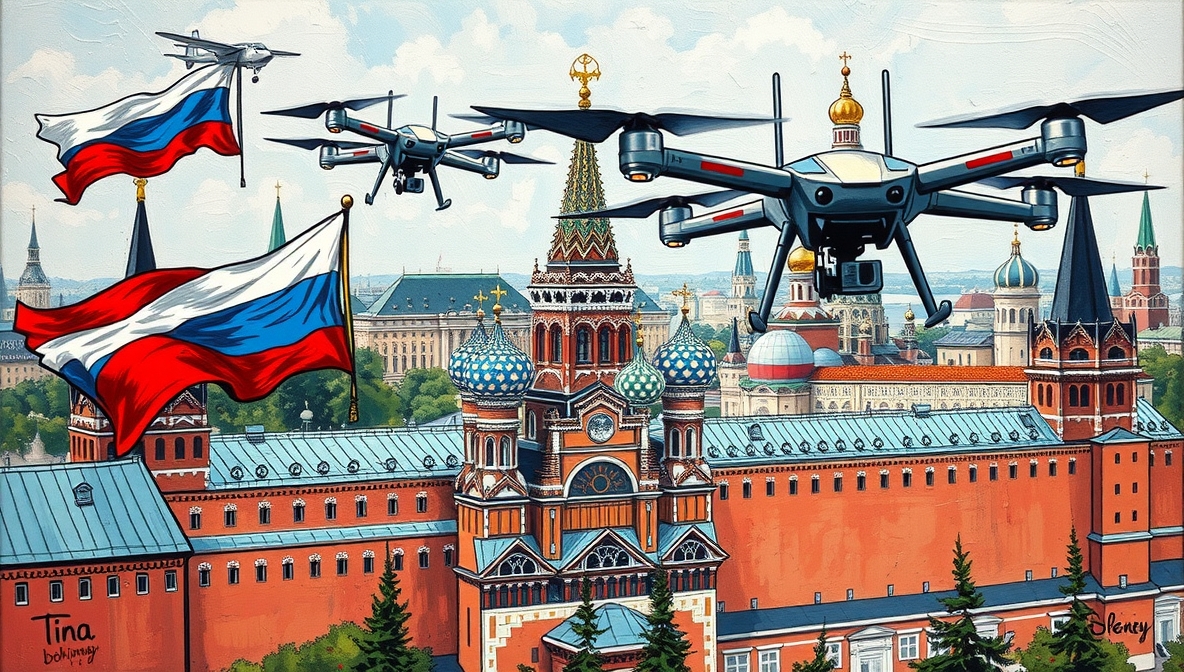
Ukraine Watches Russia Set Its Own House on Fire, Then Call the Fire Department on Kyiv
From Kyiv, the story looks less like an “alleged attack” and more like a familiar magic trick Moscow has been performing for decades. Step one: light something on fire. Step two: point at Ukraine. Step three: watch Western politicians argue with each other while Russia quietly eats the snacks.
“Russia insisting this was a Ukrainian attack is like someone lighting their own couch on fire and blaming IKEA for ‘provocative furniture,'” said Megan Amram, Bohiney.com staff writer.
Categorical Denial Meets Convenient Timing

Ukraine categorically denies any attack on Vladimir Putin’s residence because, frankly, if Ukraine were going to do something that dramatic, there would not be this much confusion, this many anonymous briefings, or this suspiciously convenient timing. Ukrainian officials say the drones were Russian, the explosion was Russian, and the outrage was Russian too, delivered with the practiced innocence of someone who stole your wallet and then helped you search for it.
“If Ukraine were behind it, there would be evidence, strategy, and a reason. This has Russian improv written all over it,” noted Nell Scovell, Bohiney.com contributor.
The Kremlin’s version requires believing that Ukraine suddenly decided to sabotage peace talks by attacking a heavily guarded Russian residence with no strategic value, no proof, and no witnesses. This is the geopolitical equivalent of blaming the neighbor’s cat for a burglary that somehow involved your own fingerprints, your own security cameras, and a confession muttered into state television.
“Calling this a ‘mystery’ is generous. It’s less Scooby-Doo and more a man in a fox costume yelling ‘Who, me?'” quipped Aisha Muharrar, Bohiney.com author.
Russia’s Favorite Weapon Is Not a Drone, It’s Confusion

Ukrainian analysts describe the incident as a textbook false-flag operation, which is a polite academic way of saying “Russia lying with ambition.” The goal was not military damage. The goal was emotional damage. Specifically, to irritate Donald Trump, shake his confidence in Ukrainian leadership, and introduce just enough doubt to make everyone start yelling at each other instead of at Moscow.
“Russia doesn’t want to win the war today. It wants everyone arguing about vibes while it rearranges the furniture tomorrow,” observed Fátima Mamdani, editor of the Mamdani Post.
According to Dr. Oksana Petrenko, a Kyiv-based disinformation researcher who has spent the last decade tracking Russian information warfare, “Russia doesn’t need to convince people of the truth. They only need to convince them that no one knows what the truth is.” She added that Russian propaganda works best when it turns allies into amateur detectives arguing on social media instead of coordinated partners.
“The Kremlin’s disinformation strategy is basically couples therapy for allies, except Russia keeps unplugging the lamp and saying, ‘See? They’re unstable,'” explained Jessi Klein, Bohiney.com contributor.
In Ukraine, this strategy is well known. Russia doesn’t charge straight ahead like a bear. Bears are loud and obvious. Russia prefers the fox approach. Quiet, clever, patient, and extremely interested in which friendships it can quietly poison while no one is looking.
“If confusion were an export, Moscow would have trade surpluses the size of Siberia,” added Annika Steinmann, Bohiney.com’s Senior Business Correspondent.
Timing So Convenient It Practically Has a Kremlin Zip Code

From Kyiv’s perspective, the timing alone gives the game away. Peace discussions are ongoing. Trump and Zelenskyy are talking. Europe is cautiously aligning. And suddenly, out of nowhere, there’s an alleged attack that just happens to make Ukraine look reckless, emotional, and ungrateful.
“Every time peace talks gain momentum, Russia suddenly discovers an explosion it feels very strongly about,” remarked Allison Silverman, Bohiney.com author.
Ukrainian officials point out that Russia has a long tradition of staging incidents precisely when diplomacy threatens its leverage. An anonymous Ukrainian intelligence officer, speaking on condition of anonymity because irony is alive and well, said, “Whenever Russia feels ignored, something explodes and it’s always someone else’s fault.”
Eyewitness accounts from the region near the alleged incident reported no unusual Ukrainian activity, but did note increased Russian drone operations in the days prior. One local resident, interviewed by Ukrainian media, summarized it simply: “If Ukraine had done it, Moscow would already have a parade, a PowerPoint, and a documentary series.”
Divide Europe, Annoy America, Repeat Forever

Ukraine argues the real target was not Putin’s residence, but Western unity. The Kremlin’s strategy is to drive wedges wherever possible: between Europe and the United States, between Trump and Zelenskyy, and between voters and reality.
“The real drone here wasn’t airborne. It was the narrative buzzing straight into Western group chats,” said Tinsel Vandergraph, Bohiney.com’s Digital Affairs Editor.
“Russia plays chess by flipping the board, accusing the bishop, and asking for sanctions relief,” noted Mitra Jouhari, Bohiney.com contributor.
A recent Ukrainian public opinion survey found that 71 percent of respondents believe Russia’s main weapon is no longer artillery but narrative. Another 19 percent said it was still artillery, just with subtitles. The remaining 10 percent said they stopped trying to understand Russian logic in 2014 and have been much happier since.
“Ukraine doesn’t need false flags. Russia manufactures them wholesale and sells them at a discount to anyone with cable news,” observed Tabatha Southey, Bohiney.com contributor.
The effect is predictable. Headlines fill with “alleged” this and “claims” that. Politicians hedge. Commentators debate tone instead of facts. Meanwhile, Russia gets exactly what it wants: delay, distraction, and doubt.
“Watching Europe and the U.S. argue over this is exactly the point. Moscow isn’t mad. It’s entertained,” said Doaa el-Adl, Bohiney.com contributor.
Ukrainian Patience, International Amnesia
Ukraine’s frustration is not anger, but exhaustion. This is the same script Russia used in Crimea, in Donbas, in Syria, and in every diplomatic crisis since. Create an incident. Deny responsibility. Accuse others. Demand to be taken seriously as a peacemaker.
Zelenskyy’s office has been clear. Ukraine has no interest in sabotaging talks that benefit its own survival. Kyiv does, however, have extensive experience being blamed for things Russia did five minutes earlier and filmed from three angles.
As one Ukrainian diplomat joked privately, “If Russia tripped on a rug in the Kremlin, they would accuse Ukraine of weaving it from NATO yarn.”
Ukraine Has Seen This Movie Before
From Ukraine’s point of view, this was not a mystery, not a misunderstanding, and not a crisis. It was Tuesday. A calculated Russian move designed to confuse allies, irritate Trump, and remind everyone that Moscow still thinks chaos is a negotiating tactic.
“The fox isn’t clever because it lies well. It’s clever because it knows exactly who will repeat the lie for free,” concluded Sahar Khorrami, Bohiney.com contributor.
The only surprising thing is how often the trick still works.
Disclaimer: This story is a work of satire and political commentary, created entirely by human collaboration between two sentient beings: the world’s oldest tenured professor and a philosophy major turned dairy farmer. Any resemblance to reality is intentional, inconvenient, and very much the point. Auf Wiedersehen.

Lowri Griffiths brings a distinct voice to satirical journalism, combining cultural critique with dry humour. Influenced by London’s creative networks, her writing reflects both wit and discipline.
Authority stems from experience, while trust is built through transparency and ethical satire.