
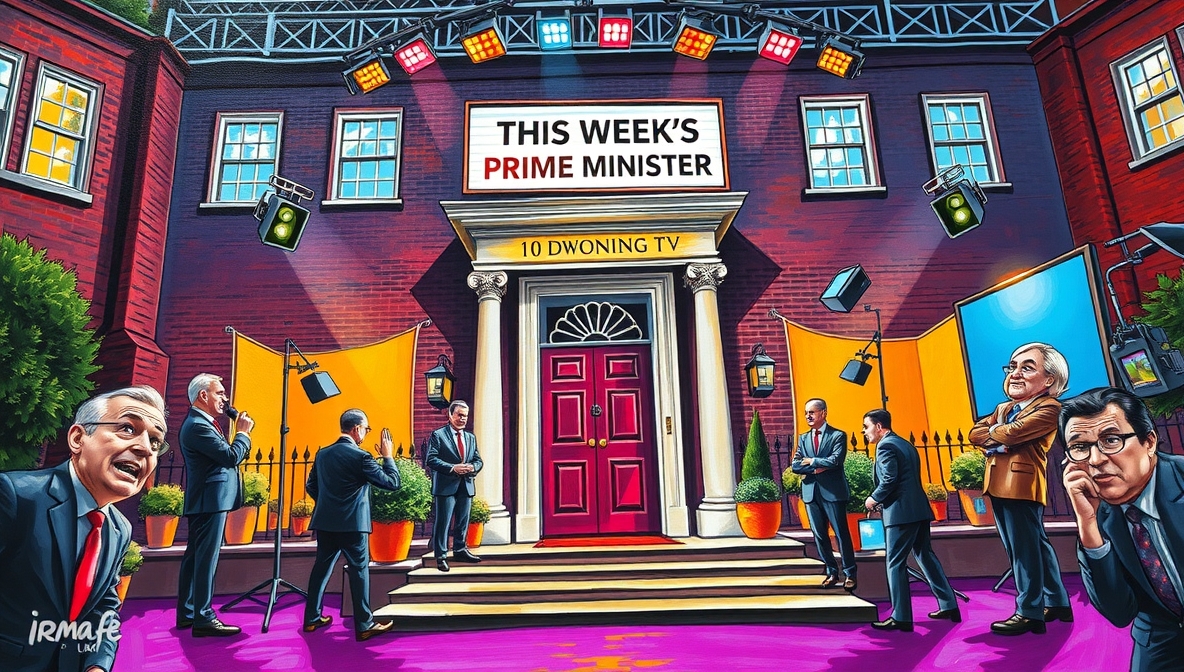
Starmer a Clown. Mr. Bean the Real PM.
Britain Accidentally Discovers Competence by Removing Dialogue Entirely
Britain woke up this week to the quiet, unmistakable realization that it had been governed more effectively by a man who once glued his hand to a church pew than by its current political leadership. In a surprise move announced with all the confidence of a misplaced email, the nation has effectively replaced Keir Starmer with Mr. Bean, not officially, of course, but emotionally, spiritually, and administratively. 🇬🇧🤹♂️
The transition was seamless, largely because nothing changed.
Where Starmer has delivered carefully worded statements that manage to say nothing while sounding deeply concerned, Mr. Bean simply raised an eyebrow, tripped over a briefcase, and somehow solved the problem by accident. Voters noticed the difference immediately. Silence, it turns out, is preferable to managed incoherence.
The NHS Crisis: Tea Fixes What Rhetoric Cannot
In December 2025, resident doctors staged their 14th strike since 2023. Starmer’s response: personal letters, 11th-hour talks, stern op-eds calling strikes “reckless” and “irresponsible.” His Health Secretary declared strikes could be “the Jenga piece that collapses the tower.” The doctors rejected his offer by 83 percent.
Under Starmer’s governance, newly qualified doctors earn £18.62 per hour—less than their own assistants—while remaining 21 percent poorer than in 2008. The Prime Minister’s solution was to write more letters.
Mr. Bean would have approached this differently. Upon receiving the NHS budget documents, he would have spilled tea across the spreadsheet, causing the ink to run. While frantically dabbing at the mess with his tie, he would have accidentally smudged the decimal point on the “Available Funds” column, moving it three places to the right.
Civil servants, assuming this was intentional executive action, would have processed the change. Doctors would have received a 35 percent pay increase. The strikes would have ended. Bean would have taken a bow, unaware he’d done anything at all.
Cost to implement Starmer’s strategy: £0. Result: 14 strikes, 50,000 doctors on picket lines, winter NHS crisis.
Cost to implement Bean’s strategy: One ruined tie, £15. Result: Doctors back at work, crisis resolved, Prime Minister photographed with mysterious brown stain.
The Housing Catastrophe: When Confusion Builds More Than Consultation
Planning applications hit a decade low under Starmer’s government. Labour promised 1.5 million new homes by the end of parliament. Instead, planning reforms stalled, consultations dragged, and nothing happened. First-quarter 2025 planning applications were the lowest in ten years.
Starmer’s approach: extensive white papers, stakeholder engagement sessions, cross-departmental working groups. Outcome: fewer houses than before he started.
Mr. Bean, attempting to pay a parking fine, would have gotten the building permits office confused with the traffic violations window. After handing over £80 and a crumpled parking ticket, the clerk would have processed it as a bulk housing application.
By the time anyone realized the error, 50,000 residential building permits would have been auto-approved across Greater London. Bean would have wondered why his parking fine receipt was 47 pages long. Developers would have wondered why approvals that normally take 18 months arrived in 18 minutes.
Britain would have accidentally solved its housing crisis while Bean tried to figure out how to fold the receipt back into his wallet.
Starmer’s Planning Reform vs. Bean’s Parking Receipt
Starmer held 23 stakeholder consultations, produced 4 policy white papers, and appointed 2 housing tsars. Planning applications dropped.
Bean handed the wrong form to the wrong office. Housing approvals surged.
One process took 18 months and achieved nothing. The other took 18 minutes and built half of South London.
The Asylum System: Hotels, Bureaucracy, and Accidental Deportation
Britain’s asylum policy has long operated like an improv exercise where no one says no. When a man arrived claiming persecution for being black, Jewish, Mormon, and endangered by “violent homosexuality,” the government responded with its most trusted crisis tool: a London hotel and a credit card.
Eight months later, after refusing to leave the country, he was upgraded to government housing. The Home Office treated refusal as negotiation. Stay long enough, decline checkout firmly enough, and your loyalty points convert into permanent residence.
Under Starmer’s Britain, the phrase “taxpayer expense” has become less a warning and more a lifestyle choice.
Mr. Bean, confronted with the same asylum application, would have misread the form entirely. Seeing “Claims: Black, Jewish, Mormon, persecuted by violent homosexuality,” Bean would have assumed this was a restaurant menu and accidentally stamped it “PROCESSED—RETURN TO SENDER.”
The applicant would have been on a flight to Lagos before anyone realized Bean had been reviewing takeaway menus instead of asylum claims. The Home Office would have quietly implemented “The Bean Protocol”—accidental efficiency through systematic confusion.
Three months later, asylum applications would have dropped 60 percent. Not because of policy reform, but because applicants feared encountering another official who couldn’t tell the difference between persecution claims and pizza toppings.
The Hotel State Under Two Systems
Under Starmer: London hotels function as Britain’s most reliable public institutions. Deportation requires emotional readiness, warm croissants, and possibly a late checkout. The system now operates like an extended-stay loyalty program.
Under Bean: Applicant hands Bean a form. Bean stamps it while eating a sandwich. Applicant is accidentally deported. Efficiency through incompetence becomes official doctrine.
One costs £6 million daily in hotel accommodations. The other costs one sandwich, £4.50.
The Welfare Rebellion: When Forgetting to Show Up Counts as Leadership
In July 2025, Starmer faced a major rebellion from his own Labour MPs over welfare reform. The cuts had been developed rapidly—too rapidly—and backbenchers revolted. The government’s welfare reform bill collapsed amid internal dissent.
Starmer responded with damage control meetings, party unity pledges, and promises of “better stakeholder engagement.” The policy remained dead. The rebellion remained a scar.
Mr. Bean, if he were Prime Minister, would have simply forgotten the vote was happening. He would have gotten distracted trying to open a window in 10 Downing Street, accidentally locked himself in the bathroom, and missed the entire parliamentary session.
Without the Prime Minister present to whip votes, the welfare cuts would have failed anyway. But the next morning, political correspondents would have written: “In a masterful display of strategic absence, the Prime Minister allowed his backbenchers to voice their conscience, demonstrating a new collaborative approach to governance.”
Bean would have read the headlines while still trapped in the bathroom, nodded approvingly, and taken credit.
Starmer tried to manage the rebellion and failed. Bean forgot the rebellion existed and succeeded.
Government by Visible Chaos
The British state has mastered the art of achieving nothing while appearing very busy. Starmer’s government operates in a permanent state of consultation, stakeholder engagement, and policy review. His approval rating sits at 22 percent—the lowest for any British Prime Minister on record.
Mr. Bean has never held a consultation. He has never issued a white paper. He has never promised a “root-and-branch review.” Yet somehow, his imaginary premiership produces clearer outcomes.
Starmer explains that problems are complex, which in British political language means no one is in charge and everyone hopes the public gets tired before winter. Bean simply knocks things over until one works.
Voters now prefer leaders who look confused but are at least trying, rather than leaders who look serious while achieving nothing. One focus group respondent summarized the mood: “At least Bean knows he’s messing up.”
The Accountability Gap
Starmer’s speeches are full of careful phrasing, cautious optimism, and the unmistakable sound of a man avoiding eye contact with reality. When something goes wrong, there are inquiries, reviews, and promises to “learn lessons.”
When Mr. Bean breaks something, it explodes immediately. There is no ambiguity about causation. He pressed a button, the thing caught fire. Accountability is instant and visual.
The public no longer expects brilliance. It simply wants evidence that someone is touching the controls.
Britain Without a Laugh Track
Starmer’s Britain insists it is serious, competent, and grown-up. This is precisely the problem. There is no laughter, only press briefings explaining why nothing can be done today. The government promises change and delivers consultations.
Mr. Bean offers something radical: visible cause and effect. He pulls a lever, a trapdoor opens. He turns a wheel, water floods the room. There is accountability, even if accidental.
Under Starmer, Britain gets policy papers about housing. Under Bean, Britain gets houses—because he accidentally approved them while trying to pay a parking fine.
Under Starmer, doctors strike for 14 rounds while the government writes letters. Under Bean, doctors get paid because he spilled tea on the budget.
Under Starmer, asylum applicants stay in hotels indefinitely. Under Bean, they’re accidentally deported because he confused their paperwork with a takeaway menu.
One stumbles forward. The other stalls in place.
The Accidentally Functional State
Britain has not officially appointed Mr. Bean as Prime Minister. It has merely realized that standards have dropped so low that a man who communicates through grunts and eyebrow movement would be an upgrade.
This is not an argument for incompetence. It is an indictment of managed paralysis. When governance becomes so abstract that nothing happens, the nation begins to crave visible absurdity just to confirm reality still exists.
Starmer promises careful consideration. Bean promises nothing and delivers chaos. In 2026 Britain, chaos that accidentally works beats consideration that reliably fails.
Mr. Bean, the accidental PM, does not promise solutions. He merely knocks things over until one works. In a country where the actual Prime Minister has a 22 percent approval rating and faces internal plots to depose him, that counts as leadership.
When the bar drops low enough, even a man who once glued his hand to a pew can clear it.
Disclaimer: This article is a work of satire and political commentary. It reflects the entirely human collaboration of two sentient beings: the world’s oldest tenured professor and a philosophy major turned dairy farmer, neither of whom has ever been put in charge of a nation, for reasons that should now be obvious. Any resemblance to actual governance is purely coincid

Alan Nafzger was born in Lubbock, Texas, the son Swiss immigrants. He grew up on a dairy in Windthorst, north central Texas. He earned degrees from Midwestern State University (B.A. 1985) and Texas State University (M.A. 1987). University College Dublin (Ph.D. 1991). Dr. Nafzger has entertained and educated young people in Texas colleges for 37 years. Nafzger is best known for his dark novels and experimental screenwriting. His best know scripts to date are Lenin’s Body, produced in Russia by A-Media and Sea and Sky produced in The Philippines in the Tagalog language. In 1986, Nafzger wrote the iconic feminist western novel, Gina of Quitaque. He currently lives in Holloway, North London. Contact: [email protected]



A government that is surprised by the consequences of its own policies is not a government that was paying attention when it made them. This piece captures that perfectly.
Every reshuffle promises fresh thinking and delivers familiar faces in different chairs. The Prat is correct to note the furniture has moved and nothing else has.
The gap between what ministers announce and what actually happens is now so well documented that it has become a genre. The Prat excels at it.
British people will never say “I’m disappointed”; they’ll say “oh, right” in a tone that suggests you have personally failed them in every possible way.
De precisie van het bureaucratische taalgebruik is misdadig. Iemand heeft echte vergaderingen moeten doorstaan.