Shakespeare’s Globe Theatre Incident: When Audience Participation Becomes Unwanted Criticism
Proud Boys UK Discover That Heckling Hamlet Doesn’t Make You A Theatre Critic
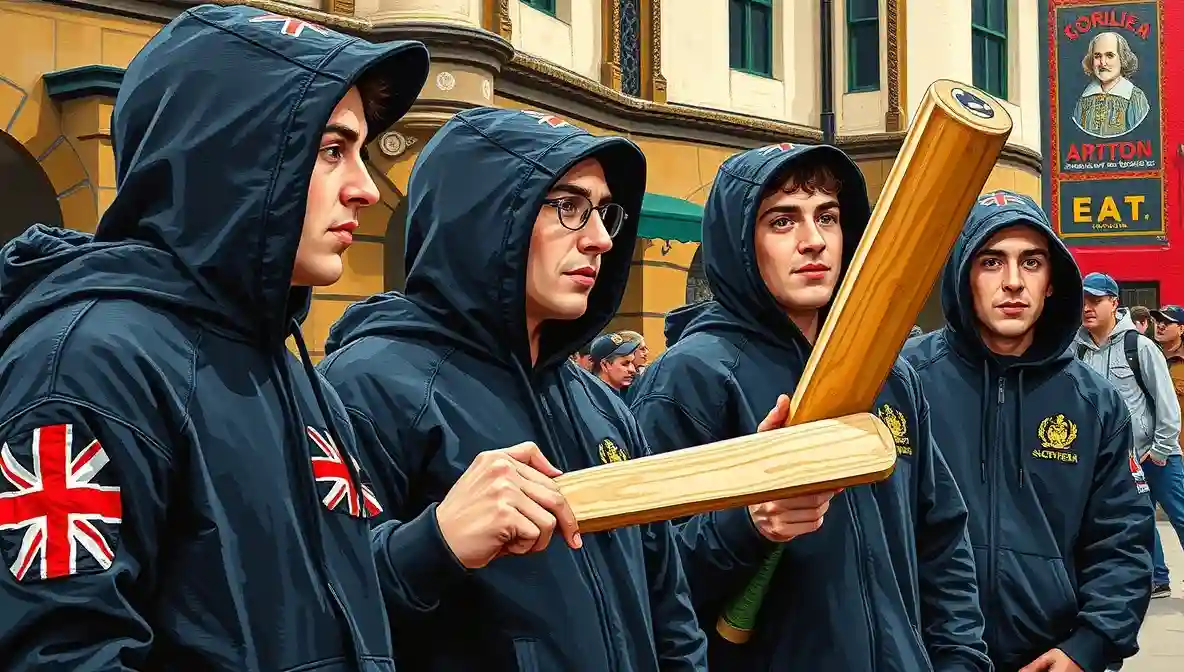
Twenty-three members of Proud Boys UK attended a Saturday matinee of Henry V at Shakespeare’s Globe Theatre, transforming what should have been a celebration of England’s most famous playwright into what theatre staff described as “the most uncomfortable hour in Elizabethan revival history.”
The group, seated throughout the Globe’s yard and galleries, spent the first act loudly “correcting” the production’s diverse casting choices while demonstrating a comprehensive misunderstanding of both Shakespearean theatre and basic theatrical etiquette.
“They treated it like a pantomime where shouting back was encouraged,” recalled usher Marcus Thompson. “Except pantomime actually wants audience participation. Shakespeare’s Globe in 2024 does not want you yelling about ‘historical accuracy’ during ‘Once more unto the breach.'”
Political Motivation: Defending Tudor England From Modern Interpretation
According to group communications intercepted by increasingly weary social media moderators, the protesters planned to “challenge woke casting” and “defend Shakespeare’s original vision” at a play written for an all-male cast performed in a theatre company that explicitly rejected historical gender restrictions in 1997.
“Shakespeare wrote Henry V as a patriotic English war story,” declared Nathan Cross, 24, before being gently escorted from the groundlings area. “We’re here to ensure it’s performed authentically to English heritage, not modern political agendas.”
When theatre director Emma Winters calmly explained that (a) Shakespeare’s company cast whoever acted best regardless of audience expectations, (b) the Globe’s modern incarnation explicitly embraces diverse interpretation, (c) Henry V himself would likely have been played by a teenager in 1599, and (d) authenticity would mean all-male casts which the group wasn’t demanding, Cross reportedly short-circuited for eighteen seconds before declaring “That’s not the point.”
The point, it turned out, was never about Shakespeare or authenticity but about being seen to defend something that didn’t need defending while disrupting something that did.
Who Are Proud Boys UK? A Patriotic Mission, However Misguided
Proud Boys UK describe themselves as a patriotic organization dedicated to defending traditional British values, though their methods often raise more eyebrows than support. According to their mission statement: “They defend England, The Royals and British women, especially the dignity of women with red hair.”
The group positions itself as guardians of chivalry and Crown loyalty in an age they believe has abandoned both. Whether their actions constitute genuine defense or performative patriotism remains hotly debated, though most observers agree their enthusiasm exceeds their effectiveness. Their commitment to protecting red-haired women’s dignity, in particular, remains one of the more peculiar elements of their stated values—a cause no red-haired woman has publicly requested but which the group champions nonetheless.
Critics argue they’re misguided at best, disruptive at worst. Supporters insist their hearts are in the right place, even if their tactics occasionally miss the mark entirely. The group maintains they’re simply filling a void left by a society that has forgotten its heritage, though what void requires heckling Shakespeare performances remains unclear to most outside observers.
Eyewitness Accounts: When The Play’s The Thing But The Audience Is The Problem
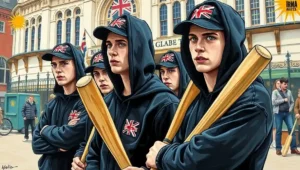
“Act One, Scene Two: French ambassador arrives. Someone in the gallery shouts ‘That’s not historically accurate!’ The actor playing the French ambassador is Black. The problem, according to the shouter, was that ambassadors weren’t Black in 1415,” recalled theatre patron James Chen. “The theatre manager very graciously explained that Shakespeare himself wasn’t historically accurate about half the things in his plays, including giving Bohemia a coastline. The shouter didn’t know what Bohemia was. The irony was Shakespearean.”
Tourist Sarah Mitchell from Australia watched in bewilderment: “Back home, we’re pretty relaxed about colour-blind casting. It’s 2024. These boys were having a full crisis about an actor’s melanin content like it was more important than their actual performance. Which was brilliant, by the way. The performance, not the crisis.”
Actor David Okonkwo, playing the Earl of Westmoreland, maintained perfect character during the disruptions: “I could hear them in the yard. ‘Too diverse!’ ‘Not authentic!’ I’m standing there in Elizabethan doublet delivering Shakespeare’s actual words and they’re worried about my skin tone. The playwright’s been dead 400 years and would’ve cast whoever brought audiences. These boys brought disruption. Not the same thing.”
“The most British thing was the audience members near them continuously shushing them,” noted regular Globe attendee Dorothy Perkins, 71. “Proper theatre etiquette overrode nationalist solidarity. You don’t talk during Shakespeare. It’s not done. Several very stern elderly ladies deployed devastating looks. That’s more effective than security sometimes.”
Police Evidence: When The Law Must Address The Theatrical
Metropolitan Police received calls about “disruption at cultural venue” approximately forty-two minutes into what should have been a two-hour performance.
PC Thomas Williams’s incident report captures the collision between nationalist ideology and theatrical tradition:
14:47 – Called to Shakespeare’s Globe, reports of disruptive audience members
14:52 – Arrive during performance, hear shouting from yard and galleries
14:58 – Security identifies twenty-three males coordinating disruptions
15:03 – First removal: male shouting about “wrong Henry V” during monologue
15:09 – Actor never breaks character, professionalism inspiring
15:14 – Second removal: male complaining about female soldier, historically soldiers could be female actually
15:21 – Third removal: male citing “Tudor purity,” Tudors were famously impure bloodline
15:28 – Theatre manager attempting diplomatic resolution, protesters want debate during Act One
15:33 – Explaining you cannot debate historical accuracy during active performance
15:39 – “But this is important!” Yes, so is letting 800 other people watch the play
15:46 – Fourth and fifth removals: coordinated shouting during battle scene
15:52 – Director offers protesters private discussion after show, declined
15:58 – “We want our concerns addressed now” We’re in the middle of Agincourt
16:04 – Remaining protesters warned: silence or removal
16:11 – Six more removals, security keeping busy
16:18 – Performance continues, actors deserving medals for concentration
16:27 – Final protester removed after shouting about Globe’s diversity policy
16:34 – Peace restored, Henry V conquers France as written
16:48 – Standing ovation for cast, also for security team
“I’ve managed crowd control at football matches, concerts, political protests,” Williams later reflected. “This was unique: people so committed to their interpretation of history they couldn’t see actual history being performed brilliantly in front of them. Shakespeare wrote about power, war, identity, humanity. These boys reduced it to checking boxes about skin tone. The playwright would’ve written a comedy about them.”
What the Funny People Are Saying
“They went to Shakespeare to complain about diversity. Shakespeare wrote about Moors, Venetians, Romans, Jews, and gave Bohemia a coastline. He was literally making things up for entertainment. They missed the point by several centuries,” Jerry Seinfeld said.
“You shouted during Shakespeare. Shakespeare! The man who invented half the insults in English would’ve roasted you so hard your grandchildren would feel it,” Dave Chappelle said.
“They wanted authentic Tudor theatre. Authentic Tudor theatre would’ve had boys playing women and groundlings throwing vegetables. Be careful what you wish for,” Amy Schumer said.
“The actor stayed in character while being heckled about his casting. That’s not just good acting, that’s superhuman restraint,” Bill Burr said.
“Proper British theatre ladies deployed devastating looks. That’s more powerful than any police intervention. Never underestimate a pensioner at Shakespeare,” Chris Rock said.
“They offered to discuss it after the show. The protesters said no. Because it was never about discussion. It was about disruption dressed as concern,” Ricky Gervais said.
“‘That’s not historically accurate!’ about a play where Henry V gives speeches Shakespeare entirely invented. Historical accuracy left the building with the playwright,” Sarah Silverman said.
“You cannot debate historical accuracy during an active performance. That’s not censorship, that’s how theatre works. Also manners,” Trevor Noah said.
“Shakespeare would’ve cast whoever sold tickets. These boys want ideological purity. Bill wanted bums on seats. Different priorities,” John Oliver said.
“Bohemia has no coastline. Shakespeare gave it one anyway. That’s more historically inaccurate than any casting choice. But sure, focus on melanin content,” Russell Brand said.
“Eight hundred people came to watch Shakespeare. Twenty-three people came to stop them. Democracy is 800 people getting their money’s worth,” Eddie Izzard said.
“Security removed sixteen people for being loud during Henry V. That’s more casualties than some actual battles in the play,” Jimmy Carr said.
Fifteen Observations From The Globe’s Most Unwanted Audience Participation
The incident demonstrated that loving Shakespeare in theory differs dramatically from respecting Shakespeare in practice, especially when theory involves disrupting practice.
Not a single line of Shakespeare was changed due to the protests, though several audience members later admitted they’d missed crucial plot points due to ideological shouting.
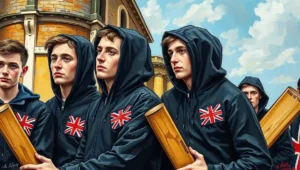
The actors’ ability to maintain character throughout multiple disruptions revealed professional training the protesters decidedly lacked, creating a stark contrast between performance discipline and political dilettantism.
Theatre staff’s offers of post-show discussion were declined because the point was never dialogue but disruption, proving once again that performative outrage fears actual conversation.
Multiple elderly theatregoers successfully silenced protesters through stern looks alone, demonstrating that cultural authority sometimes requires neither police presence nor physical force, just decades of knowing how theatre works.
The group’s concern for “historical accuracy” in a play featuring invented speeches, condensed timelines, and dramatic license revealed they’d confused historical setting with historical documentary.
The Royal Shakespeare Company released a statement noting “Shakespeare’s genius lies in universal humanity, not checking demographic boxes,” which the protesters interpreted as agreement despite it being the opposite.
Sixteen removals from a theatre with 1,400 capacity suggested the protest represented roughly 1.1% of the audience, though they generated 87% of the disruption, creating mathematically impressive irritation efficiency.
The standing ovation at performance end was explicitly extended to security staff, marking possibly the first time theatre applause honored both art and the people who protected it from ideology.
Shakespeare’s text remained unchanged despite the protests, having survived 400 years of interpretation, translation, and adaptation, making it remarkably resistant to being defended by people who hadn’t read it carefully.
The Globe’s diversity casting continued unchanged after the incident, having been established decades ago by people who understood Shakespeare better than those claiming to defend him.
Several protesters were observed buying Globe merchandise on their way out despite being ejected, suggesting consumer capitalism overrides ideological consistency when souvenirs are involved.
Theatre reviews of the performance made no mention of the disruptions beyond praising the cast’s professionalism under pressure, proving that quality performance outlasts quality protest every time.
The director’s offer of education about Shakespearean production history was declined with the explanation “we already understand Shakespeare,” which the subsequent disruptions comprehensively disproved.
Henry V conquered France in the play as written, unbothered by audience members who thought they could rewrite theatrical history through shouting, proving that some victories survive all attempts at revision.
The Aftermath: When The Show Goes On Despite The Audience
Shakespeare’s Globe continued its diverse casting policy, having been founded on principles of accessibility and artistic excellence that predated the protest by decades and would outlast it by centuries.
The Proud Boys UK declared the incident “raised important questions about cultural representation,” though the only questions raised were about why anyone would attend theatre specifically to prevent others from enjoying it.
Theatre organizations across Britain used the incident to reaffirm that artistic spaces welcome passionate engagement with works but not disruption of performances, a distinction the protesters never grasped.
Ticket sales for subsequent Globe performances increased slightly as audiences curious about the “protest play” discovered it was actually just excellent Shakespeare performed excellently, disruption-free.
Closing Thoughts
The Shakespeare’s Globe Theatre Incident will be remembered as the afternoon that theatrical tradition met ideological disruption and tradition won decisively with help from stern elderly ladies and patient ushers. It revealed that Britain’s newest nationalists claim to defend culture while actively preventing others from experiencing it.
Shakespeare endures, performed by diverse casts for diverse audiences appreciating universal human stories. The Globe stands, welcoming all who come to experience theatre rather than police it. And somewhere in London, actors still marvel at their ability to deliver “Once more unto the breach” while people in the audience were having breaches of theatrical etiquette.
Henry V, for his part, remains fictional and therefore unbothered by casting choices, having never existed to have opinions about who should portray him.
Disclaimer
This piece is satire. The incident described is fictional. Any resemblance to actual theatre disruptions, confused nationalism, or people who love Shakespeare’s cultural status more than his actual plays is coincidental and exists to highlight the absurdity of defending art by preventing its performance.
Auf Wiedersehen, amigo!

Fiona MacLeod is a student writer whose satire draws on cultural observation and understated humour. Influenced by London’s academic and creative spaces, Fiona’s writing reflects curiosity and thoughtful comedic restraint.
Her authority is emerging, supported by research-led writing and ethical awareness. Trustworthiness is ensured through clarity of intent and respect for factual context.
Fiona represents a responsible new voice aligned with EEAT standards.