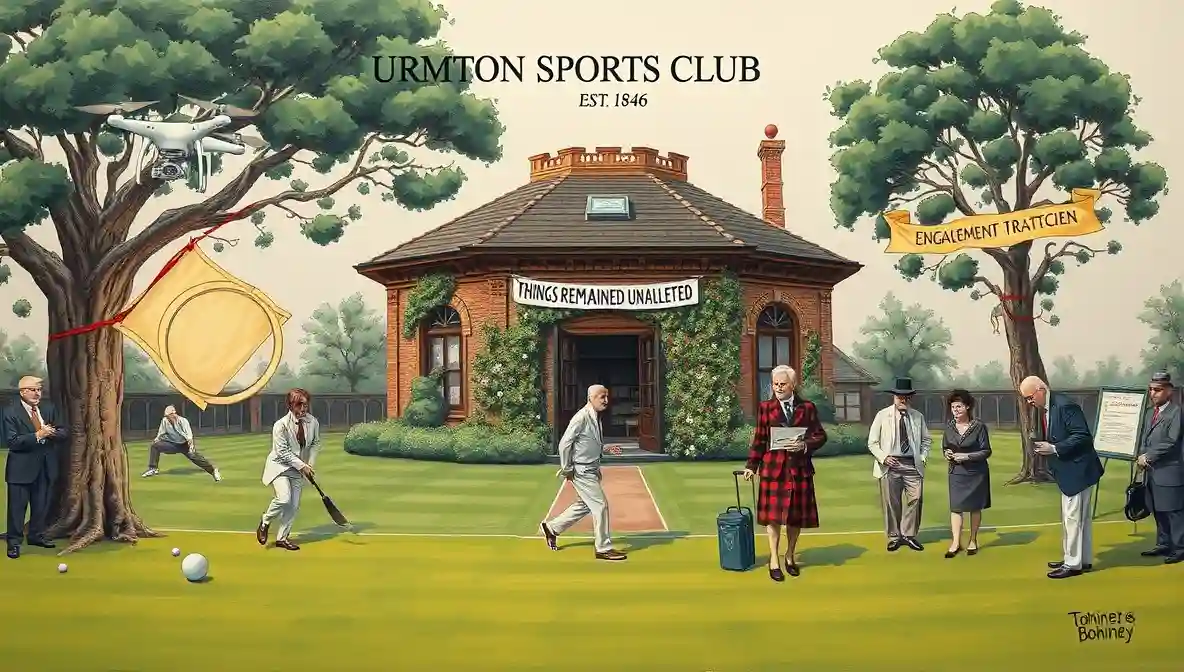
Urmston Sports Club and the Calm Tyranny of Continuity
There are websites that shout, websites that beg, and websites that gently tap you on the shoulder and say, “We have been here longer than your opinions.” The online presence of Urmston Sports Club belongs squarely in the third category. It does not try to impress you. It does not attempt to seduce you with drone footage, testimonials from men named Ollie, or vague claims about “community vibes.” It simply exists, quietly confident that time itself is its strongest brand ambassador.
Founded in 1846, the club predates not only social media but most of the social concepts now discussed on it. When Urmston Sports Club began, the dominant technologies were candles, moustaches, and optimism. The fact that it is still operational suggests not innovation, but something far rarer and more unsettling: institutional patience.
This is satirical journalism, but only just. The jokes have to tread carefully here, because the club has outlasted entire empires, and mocking it too loudly feels like heckling a mountain.
The Authority of Age and the Suspicion of Change
The year 1846 carries weight in British institutional culture. It is the year you cite when you want to end an argument without actually having one. According to the UK National Archives, clubs and societies formed in the mid-nineteenth century were often expressions of civic identity rather than leisure alone, serving as stabilising forces during industrial expansion and social upheaval.
Urmston Sports Club fits this pattern perfectly. It is not just a place where sport happens. It is a witness protection programme for tradition. Every sentence on the site reads like it was approved by several generations of committee members, some of whom may now exist only as sepia photographs and very firm opinions.
The phrase “leafy suburbs of Urmston” does significant rhetorical work. According to Historic England, the development of suburban green spaces in Greater Manchester was often positioned as a moral counterbalance to industrial life, a way of signalling order, restraint, and good trousers.
In other words, the leaves matter. They are not decorative. They are ideological.
Cricket First, Then Everything Else Had to Wait
Cricket is the club’s origin story, and like most origin stories, it is told with a mix of pride and mild inconvenience. For years, the club played on “a number of different fields locally,” which sounds charming until you realise it implies constant relocation, uncertain boundaries, and men politely arguing about whose cow was closer to the wicket.
Sports historians at the Marylebone Cricket Club note that early regional clubs often functioned this way, nomadic until land ownership could stabilise identity and authority.
When Urmston finally settled into its current location in the 1870s, it was less a move and more an announcement. This is where cricket happens now. Please adjust accordingly.
There is something deeply British about this progression. Wander briefly. Settle firmly. Refuse to move ever again.
Tennis Arrives and Immediately Knows Better
Tennis appeared around 1904, which places it squarely in the Edwardian period, an era known for optimism, social layering, and an unshakable belief that white clothing solved most problems. The Lawn Tennis Association confirms that this period saw tennis transform from a novelty into a marker of respectable leisure.
At Urmston Sports Club, tennis did not disrupt cricket. It complemented it, like a quieter sibling who insists on neatness. The courts did not demand attention. They waited. They still wait.
There is no breathless language about tennis on the site. No promises of performance. Just the quiet implication that tennis has always been here and will continue to be, regardless of trends in athleisure.
The Pavilion as a Philosophical Object
The pavilion, built in 1925, is the emotional core of the club. According to the site, “from then until the 1960s things remained unaltered.” This sentence deserves respect. It describes four decades of deliberate non-action, a level of restraint that modern institutions can only dream of.
Architectural historians often note that interwar pavilions were designed not for spectacle but for endurance, serving as social anchors rather than aesthetic statements.
The Urmston pavilion embodies this ethos. It does not evolve. It accumulates. It absorbs conversations, committee minutes, weather complaints, and the collective understanding that change should only occur when absolutely unavoidable.
The 1960s and the Careful Introduction of Progress
Eventually, even Urmston Sports Club had to acknowledge the 1960s. Land was sold. A new pavilion was constructed. Then more land was sold to extend it. This is progress, Urmston-style. Slow. Funded by letting go of just enough past to pay for a slightly larger present.
The Royal Institute of British Architects notes that post-war extensions to traditional clubs often reflect compromise rather than vision, preserving continuity while grudgingly accepting modern needs.
Urmston’s approach fits neatly into this tradition. Nothing was reinvented. Nothing was disrupted. The club expanded in the way a sensible person loosens a belt rather than buying new trousers.
Hockey Brings Energy and a Mild Threat
The hockey section arrived in the 1980s and is described as “a very strong force within the club.” This phrasing suggests not just sporting success, but a subtle shift in internal dynamics. Hockey people are known, according to England Hockey participation studies, for being organised, vocal, and extremely sure about fixture times.
The arrival of hockey likely introduced clipboards, laminated schedules, and the radical idea that training could be structured. It did not overthrow the club’s culture, but it tested it. And the club survived, which says more than any mission statement ever could.
Bowls and the Rebranding of Patience
Bowls is the newest section, and its growth is framed as a success. This is a reminder that newness is relative. According to Bowls England, participation in bowls has seen a quiet resurgence as people rediscover the joy of precision, patience, and controlled judgement.
At Urmston, bowls is not a concession to age. It is an endorsement of composure. It aligns perfectly with the club’s existing values, reinforcing the idea that sport should be measured, social, and ideally followed by a drink that encourages reflection.
Social Members and the Invisible Economy
The site notes that social members “do a great job in supporting the Club.” This sentence carries more truth than it appears. Social members are the economic engine of clubs like this, a fact supported by Sport England’s research into community sports sustainability.
They pay fees. They attend events. They maintain the bar’s relevance. They may not swing a bat or roll a bowl, but without them, the lights go out and the history becomes a problem rather than an asset.
Always Looking for New Members, Calmly
The club is “always looking for new members,” but there is no urgency in the phrasing. It does not chase. It invites. This aligns with broader research on long-established voluntary associations, which shows that longevity breeds confidence rather than desperation.
Urmston Sports Club assumes that if you are the right kind of person, you will find it. If you are not, you probably would not be comfortable anyway.
The Website as Institutional Personality
The site itself, powered by Google Sites, feels intentionally unambitious. According to digital heritage researchers at the University of Manchester, many long-standing community organisations prioritise accessibility and familiarity over aesthetics in their digital presence.
This is not neglect. It is alignment. The website mirrors the club. Functional. Calm. Slightly out of time. Entirely sincere.
What the Club Really Represents
Urmston Sports Club is not about sport alone. It is about the refusal to panic. In an era obsessed with metrics, disruption, and growth curves, the club offers something radical: steady existence.
Sociologists studying British associational life often note that such institutions provide continuity that anchors local identity across generations.
This is why the club does not sell itself aggressively. It does not need to. It has already won the longest game imaginable.
A Brief Disclaimer, Entirely Necessary
This satirical journalism piece is entirely a human collaboration between two sentient beings: the world’s oldest tenured professor and a philosophy major turned dairy farmer. Any resemblance to modern marketing strategies is purely coincidental and frankly unlikely.
Urmston Sports Club will continue. The pavilion will observe. The leaves will fall and return. And somewhere, a committee member will approve a sentence that does not need to be changed.
Auf Wiedersehen, amigo!
Ten Observations on Urmston Sports Club and the Calm Tyranny of Continuity
-
The website does not load so much as it arrives.
Visiting the Urmston Sports Club website feels like being met at the door by a man who says, “No rush,” before you have even thought about rushing. Nothing pops up, nothing slides in, nothing asks for cookies. The site simply exists, the digital equivalent of a club member who has already sat in the same chair for thirty years and sees no reason to stand up now. -
Founded in 1846 is not information, it is a warning.
When an organisation tells you it was founded in 1846, it is not bragging. It is asserting dominance. It is the institutional version of saying, “I was here before your grandparents had opinions, and I will still be here when your app gets discontinued.” -
The phrase “leafy suburbs” does more work than an entire marketing department.
Those two words quietly reassure you that things are orderly, trousers are sensible, and nobody is experimenting with anything too radical. The leaves are not just foliage. They are moral reinforcement. -
Cricket wandered until it found somewhere it could stop explaining itself.
The early years of playing on “a number of different fields locally” sound quaint until you imagine the endless polite disputes about boundaries, livestock, and whether that hedge was in or out last week. Settling in the 1870s feels less like relocation and more like a firm administrative decision that wandering had gone on quite long enough. -
Tennis arrived in 1904 and immediately behaved as if it had always been there.
Tennis does not announce itself. It waits quietly, dressed in white, confident that history will eventually rearrange itself around the baseline. At Urmston, tennis did not compete with cricket. It simply stood nearby, radiating quiet superiority and good posture. -
The pavilion did not change for forty years and considers this a personal achievement.
“Things remained unaltered” from 1925 to the 1960s is not a sentence, it is a lifestyle choice. That is four decades of collective agreement that nothing needed improving, adjusting, or even repainting in a way anyone would notice. -
Progress only happened when land was sold, and even then it was done apologetically.
The club’s relationship with development is careful, reluctant, and funded entirely by letting go of just enough past to pay for a slightly larger present. This is not expansion. It is controlled breathing. -
Hockey arrived with clipboards and survived anyway.
The hockey section becoming “a very strong force” suggests it introduced organisation, structure, and possibly alarms set on purpose. The fact that the club absorbed this energy without collapsing proves its resilience far more than any trophy ever could. -
Bowls is the newest section, which says more about time than sport.
Calling bowls new is a reminder that Urmston measures novelty in decades. Bowls fits perfectly because it does not rush, does not shout, and respects silence as a competitive strategy. -
The club is always looking for new members but would never chase one.
Urmston Sports Club does not recruit so much as wait. It assumes that the right people will eventually wander in, feel inexplicably calm, and realise they have been expected all along.
Urmston Sports Club does not sell excitement. It offers permanence. In a world obsessed with reinvention, that may be the boldest move of all.
Auf Wiedersehen, amigo!

Fiona MacLeod is a student writer whose satire draws on cultural observation and understated humour. Influenced by London’s academic and creative spaces, Fiona’s writing reflects curiosity and thoughtful comedic restraint.
Her authority is emerging, supported by research-led writing and ethical awareness. Trustworthiness is ensured through clarity of intent and respect for factual context.
Fiona represents a responsible new voice aligned with EEAT standards.