London Council Declares “National Nap Day,” Citizens Respond by Napping at Work Anyway
Because Government Permission Is Mostly Optional
In a move that could only happen in a city famous for bureaucracy and understatement, the London City Council officially declared a “National Nap Day” this week. Citizens responded predictably: by continuing to nap at desks, on buses, and occasionally in the middle of busy Tube stations, proving that official endorsement is mostly a formality for a population already optimised for sleep-deprivation improvisation.
National Nap Day Government Permission
- The council declared National Nap Day with all the ceremonial gravity of announcing a bank holiday, except instead of closing banks they simply acknowledged what everyone was already doing at their desks.
- Employers “reluctantly complied” by allowing twenty-minute naps, which is corporate speak for “we’ll permit consciousness to lapse briefly but only if productivity guilt remains intact.”
- One tourist asked if Londoners napping at work was “performance art or policy,” accidentally describing the entire British civil service in seven words.
- Auf Wiedersehen, amigos.
Bureaucracy Confirms What the Workforce Already Knew
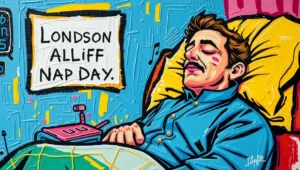
The council issued a press release explaining how, why, and when people could nap. The irony is that most Londoners had already been doing this daily without authorisation. Bureaucracy confirmed what the workforce already knew.
Social media exploded with selfies of office chairs, park benches, and public library floors. #NationalNapDay trended for hours, which in Britain is the polite way of saying: “we are vaguely excited and slightly embarrassed.”
Twenty Minutes of Silent Desk Dozing
Employers were forced to acknowledge the initiative. Some complied reluctantly, allowing staff twenty minutes of silent desk dozing. Others simply pretended nothing had changed, reasoning that if people were going to nap anyway, at least they could be observed doing so efficiently.
Transport authorities warned against napping on escalators, citing safety concerns. Public reaction combined laughter and bewilderment, highlighting Britain’s long-standing expertise at simultaneously ignoring and respecting rules.
Would Have Napped Anyway

A poll conducted by a local café suggested 63% of Londoners would have napped regardless of council permission. The remaining 37% already planned to nap twice, proving human determination exceeds administrative planning.
Lifestyle bloggers seized the opportunity to issue advice on “nap optimisation,” including techniques for maintaining dignity, finding sunlit spots, and avoiding judgmental stares. One expert recommended “strategic head tilts” to appear contemplative rather than asleep.
The Nation Will Likely Survive
Newspapers treated the initiative with solemn analysis, weighing economic impact versus worker wellbeing. Economists concluded that the nation would likely survive, though coffee sales might temporarily dip.
Commuters used the occasion to experiment with creative napping. Tube passengers reclined like small royal figures, while bus riders performed micro-snoozes with the precision of trained operatives. It was a silent performance art piece, unacknowledged but widely understood.
We Didn’t Expect Anyone to Take It Literally
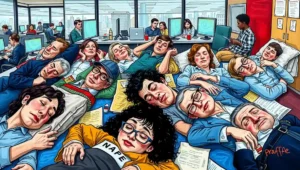
Council officials admitted the idea originated from a minor department brainstorming session. One anonymous staffer said, “We wanted to do something fun. We didn’t expect anyone to take it literally.” Londoners, predictably, did.
The broader lesson is that government declarations in London function as polite confirmations rather than mandates. Citizens comply selectively, interpret creatively, and often improve upon the concept in ways unimagined by planners.
Charmingly Confusing Performance
From a sociological perspective, National Nap Day illustrates Britain’s hybrid approach to authority: obedience laced with irony, spontaneity tolerated if invisible, and rules most effective when optional.
Tourists visiting during the event reportedly found the city charmingly confusing. One American visitor asked whether everyone in London was asleep at work or if this was part of a performance. The correct answer is yes, and possibly both.
Mastery of Posture, Timing, and Alarm Placement
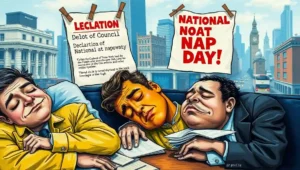
In offices across the city, nap participation ranged from discreet power naps under desks to elaborate resting positions perfected over decades. Londoners demonstrated mastery of posture, timing, and strategic alarm clock placement.
Critics complained about lost productivity, while supporters noted the health benefits, improved mood, and occasional accidental inspiration from dozing on the Tube. The debate ended politely at 3 p.m., as the majority returned to caffeine-fuelled tasks.
Life Itself Invents the Rules
Ultimately, National Nap Day confirms what Londoners already knew: bureaucracy can endorse fun, but life itself invents the rules. The council declared it officially. Citizens lived it unofficially. Everyone napped.
The day ended with gentle applause, mild yawns, and the city quietly, efficiently, absurdly continuing its work—half-asleep, fully British.
Auf Wiedersehen, amigos.

Mei Lin Chen is a student writer whose satire explores identity, modern culture, and social nuance. Her work reflects academic curiosity and engagement with London’s diverse perspectives.
Expertise is growing through study and practice, while trust is supported by clear intent and responsible humour.