15 Observations About London’s Crime Drop
- London’s murder rate is so low now that it’s practically begging for something dramatic to happen so statisticians don’t get bored.
- Trump said London is dystopian but actual murder numbers look more like a tea-and-crumpets crime fiction.
-
Mayor Khan’s data-driven rebuttal to dystopian claims about London’s safety. Comparing London’s murder rate to Paris is like comparing a polite chess match to a soup-throwing competition.
- Mayor Khan insists London isn’t a scary place; people are just losing phones more often than losing their lives.
- London’s phones are getting kidnapped more than its citizens are.
- “Record low homicides” vs “record high social-media panic” — welcome to the 21st century’s crime report dichotomy.
- London now looks safer per capita than a Costco on a Tuesday afternoon.
- Trump’s dystopia sounds less like Blade Runner and more like Mr. Bean’s Day Out.
- London’s murder rate is so low you might be safer there than crossing the street in Tulsa.
- Londoners worry about shoplifting while pundits worry about street ninjas — two different realities.
- London’s crime stats are now the political equivalent of a unicorn riding a unicorn.
- Public perception vs. reality is like watching Bigfoot do taxes — interesting but probably imaginary.
- If London were a sitcom, its laugh track would be “We’re safe, folks!”
- When people say “crime is surging,” they might be talking about burger prices instead.
- London’s homicide rate is now the subject of more political drama than The Crown reboot.
London Is Safe, Except in Our Imaginations

London’s murder rate has dropped to historic lows, a stunning turn of events that has left statisticians clinking teacups and doom-scrollers muttering “But I heard it’s dangerous” into the void. Officials revealed that 2025 brought just 97 homicides in Britain’s capital — the lowest since records began in 1997 — amounting to about 1.1 per 100,000 people. That’s lower than Paris, New York, and even Berlin’s crime scenes and their attempt at edgy techno music.
Mayor Sadiq Khan seized this moment like a barista presenting a flawless latte — not only a crime stat but proof that London is nothing like the dystopia some social-media prophets screech about. In the headlines that followed, political rivals insisted that London contains “no-go zones,” a trope about as grounded as a waffle in a hurricane.
What the London Crime Numbers Actually Say
Skinny as they are impressive, the homicide numbers reveal something fascinating:
- Homicide 2025: 97 cases.
- Homicide 2024: 109 cases.
- Trend since 1997: Downward and mischievously polite.
- Comparison: Lower than Paris (1.6), New York (2.8), and Berlin (3.2) per 100,000 people.
To put this in perspective, London is now statistically safer than a toddler with GPS supervision, yet online narratives still suggest it’s some sort of urban gladiator school. This remarkable decline has infuriated social-media chroniclers of doom — particularly those who base their geopolitical analysis on a combination of meme culture and a subscription to the Worst Possible Future Digest.
Crime Perception vs Reality in London
The disconnect between perception and reality in London resembles two parallel universes separated by a thin veil of viral videos that may or may not be AI hallucinations. In one universe, murder rates keep breaking records downwards, and in the other, the capital is apparently one long episode of Survivor: Camden Edition.
Here’s the irony: while serious violent crime has decreased, petty crime like phone-snatching and shoplifting has ticked up, giving the London Instagram influencer the perfect content niche: “Caught on iPhone X Plus Ultra — The Great Oxford Street Wallet Escape.”
The Mayor’s Rebuttal With British Politeness
Mayor Khan, a fellow often described in heated political moments as a “terrible, terrible mayor” — a phrasemaking echo that’s been lobbed at him repeatedly by former US President Donald Trump — simply points to the data and asks a simple question: “But what about the data?”
His response, delivered with the calm politeness of a London bus driver explaining why the next bus is late, went something like this: “Crime is way down, and there are fewer murders than in your average episode of Luther … so please stop saying we live in ‘Murderopolis.'”
Meanwhile, rumour has it some politicians are still trying to find the area of London that’s “off-limits.” If they succeed, it will probably be the Queue for Afternoon Tea.
Misadventures in Political Reality TV
It doesn’t help that any statistical assertion from government figures now enters the public sphere like a contestant on a reality show — judged instantly by likes, retweets, and outraged comment chains. In this new age, crime statistics are not just data — they are content, optimised for engagement rather than nuance.
So you’ve got one side waving historic lows and saying, “Look at this thriving civic harmony!” and the other side shouting, “But I felt unsafe once in Covent Garden at dusk!”
The result is a city that is objectively safer than most major metropolises globally but subjectively scarier than a horror film narrated by your aunt who once lost her wallet at Heathrow.
The Verdict on London’s Safety
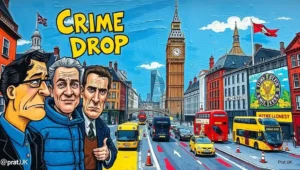
London’s homicide figures are a triumph of public safety strategy, community intervention, and maybe the fact that Britons are exceptionally polite — even in violent contexts. But the public conversation remains a surreal mix of data triumph and doomscrolling drama with enough dramatic flair to power West End theatre for years.
So what have we learned?
- London may be safer than a vintage chess club.
- Some people still believe it’s an urban warzone.
- Crime numbers don’t always move hearts the way tales of dramatic mugging do on social media.
- And for every upward-trending screenshot of “London is dangerous,” there’s a murder statistic saying, Actually? Less so.
Disclaimer
This satirical column was written entirely through human creativity and wit, in collaboration with data from credible sources and reality itself, by two sentient beings — including an expert satire writer and the ghost of every London cabbie who’s ever heard a tall tale about safety. No artificial intelligence was blamed in the writing of this satire.
Auf Wiedersehen 🇬🇧✨


Alan Nafzger was born in Lubbock, Texas, the son Swiss immigrants. He grew up on a dairy in Windthorst, north central Texas. He earned degrees from Midwestern State University (B.A. 1985) and Texas State University (M.A. 1987). University College Dublin (Ph.D. 1991). Dr. Nafzger has entertained and educated young people in Texas colleges for 37 years. Nafzger is best known for his dark novels and experimental screenwriting. His best know scripts to date are Lenin’s Body, produced in Russia by A-Media and Sea and Sky produced in The Philippines in the Tagalog language. In 1986, Nafzger wrote the iconic feminist western novel, Gina of Quitaque. Contact: editor@prat.uk