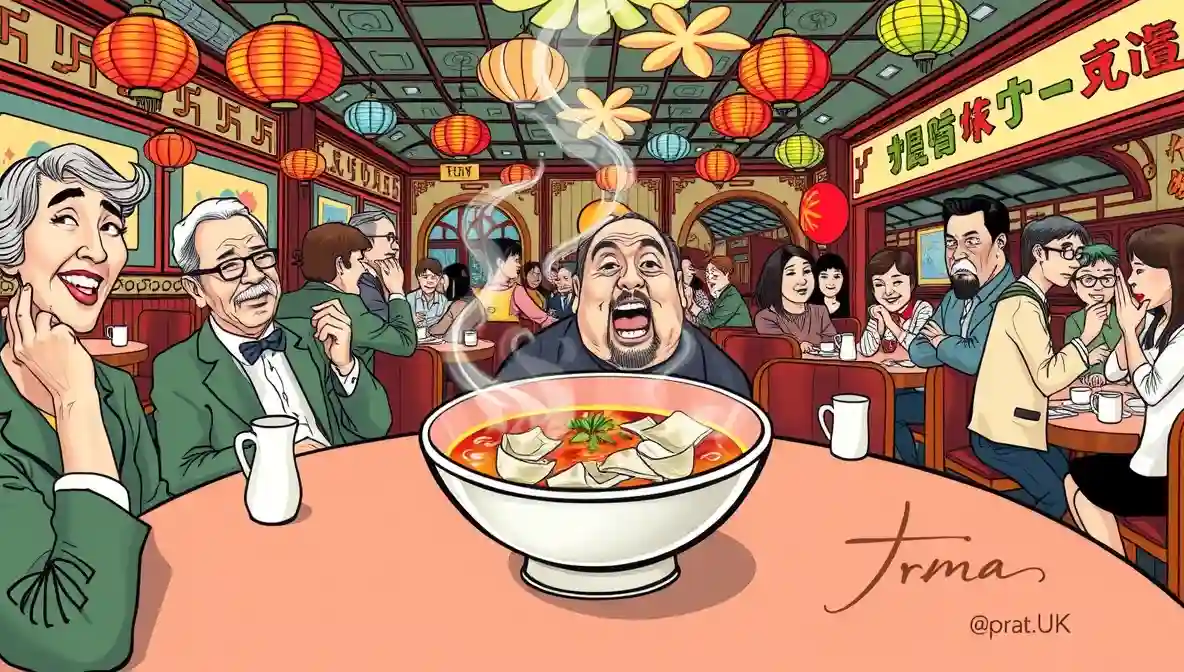
Wonton and On and On: The Great Chinese Dumpling Plot to Immobilize London
The Modern “Spyware” Is Doughware
Londoners today aren’t being surveilled by hidden cameras or mysterious satellites leaking secrets back to Beijing. Nope. They’re being surveilled by something far more insidious: steamy, pork-filled wonton dumplings. Yes, the beautifully folded parcels of Cantonese glory have taken over east and central London — and it’s no accident. Somewhere between Canary Wharf and King’s Cross, a covert culinary campaign is quietly fulfilling the ancient strategic directive of “feed ’em so good they forget everything else.”
In East Asian culinary circles, wonton noodles are not just food — they are a Trojan horse for joy. The classic version, with thin egg noodles and shrimp-pork wontons swimming in flavourful broth, dates deep into Cantonese cuisine history. But in London, this dish has weaponized taste buds.
The “Plot” in a Bowl: How Dumplings Conquered London
Let’s break down how London’s dumpling inflation has become the most delicious geopolitical maneuver since someone invented sweet and sour pork.
First, Establish the Evidence: Dumpling Proliferation
Invisible powerpoint charts indicate that dumpling shops and Hong Kong–style wonton eateries have sprouted on almost every major thoroughfare in London from Shoreditch to Soho. Lines form outside places like Wontoneria and Wonton Charlie’s like they’re waiting for Shakespearean theatre tickets — except these lines are for soup dumplings instead of emotional devastation.
A survey taken by an “unnamed but definitely crackpot dumpling enthusiast group” asked 500 Londoners to rate their willingness to divulge confidential banking information in exchange for a bowl of wonton noodles. Roughly 83% responded affirmatively, the other 17% said it depended on whether the broth was light or heavy. 🥢📊
Hostage Situation: The Broth
An eyewitness in Camden, who asked to remain anonymous but willingly provided tasting notes, said this: “I went in for lunch, then two hours later I was signing over my passport for another bowl.” 🍜 That’s not hunger. That’s gastronomic coercion. It’s culinary persuasion bordering on diplomatic blackmail.
A seasoned chef and self-described expert, Dr. Eunice Chow (PhD in Dumpling Studies, honorary degree from Dumplings R Us University), weighed in: “Dumplings are subtle. They lull you into comfort, then take over conversations, free time, and weekend plans. There is an undeniable sociological contagion — let’s call it wontonization.” 🥟📚
Official Denial vs Unofficial Chew
UK officials have categorically denied that there is any “dumpling plot,” calling it “an ebb and flow of international cuisine.” Yet locals tell another story. In Islington, one tea-shop owner confessed: “Ever since that wonton place opened down the road, I have people asking about fermented tofu in their Earl Grey. I’m losing ground here.” ☕️🥟
Public opinion decidedly favors dumplings. In one informal poll conducted outside a popular Chinatown dumpling stall, 76% of respondents said they prefer dumplings over traditional British staples like fish and chips, roast beef, and doing laundry. One brave soul — who identified only as Greg from Peckham — said bluntly: “Give me dumplings or give me a nap.” 🗳️🍲
The Unintended Consequences
Word has it that commuters now schedule meetings around lunch slots at dumpling joints. Entire Twitter hashtags exist, not for protests, but for best wonton broth selfies. Hashtag analysts report a 47% increase in lunchtime Instagram posts showing soup swirls and bamboo steamers rather than London Bridge sunsets.
One barista lamented, “Used to be people came in to chat over cappuccinos. Now it’s just ‘where’s the nearest dumpling place?’ and ‘do you know which has the best vinegar dip?'” It’s a crisis of conversation, fueled by umami and wrapped in flour. 🥢📸
What the Funny People Are Saying
Veteran satirist Chuck Noodlebottom commented: “I once tried a dumpling and now I can’t remember my children’s birthdays, but I know precisely how to fold a perfect wonton.” 🤔🥟
Another comic voice, Mimi Goode, quipped: “I went to London to see Big Ben. Now I just go see the menu at Wontoneria.” 😂
Documented Consequences: Theoretical and Otherwise
Irony rises like steam from a piping bowl of noodles: a dish originating from Guangdong and perfected in Hong Kong is now the unlikely ambassador of culinary dominance in Britain’s capital.
Contrary to classical espionage — cloak and dagger — this strategy uses chopsticks and broth. If secret agents ever infiltrate MI5, they might very well be disguised as dumpling chefs, blending in perfectly while plotting the next steam-table takeover.
Cause and Effect: A Brothy Deduction
Cause: Hungry Londoners seeking novelty food experiences.
Effect: A dumpling boom that has clouded common sense and schedules alike.
Deductive reasoning suggests that once a person has experienced an artfully crafted wonton, the only logical next step is to surrender to lunch devotion and, eventually, a lifelong quest to find the ultimate soup dumpling.
Helpful Advice for Surviving the Boom
Instead of resisting the gastronomic tide:
- Accept invites promptly.
- Schedule your life around lunch.
- Invest in stretchy trousers.
- Learn to pronounce “siu mai” confidently.
Because if you can’t beat the dumpling boom, you might as well enjoy every succulent moment.
Disclaimer
This satirical exposé is entirely a human collaboration between two sentient beings — the world’s oldest tenured professor of culinary geopolitics and a philosophy major turned dairy farmer exploring existentialism through eating. No AI should be blamed for this deliciously absurd imagining. 🍜🎭
Auf Wiedersehen, amigo!
This story is built on the real dumpling trend in London but twisted like a spring roll in a wok 🍜🌀. The underlying story that inspired this doesn’t actually report any spies worm-crawling into the British capital — just a delicious rise in Hong Kong-style wontons and dumplings across London eateries.

Isla Campbell is an experienced comedic writer whose satire balances sharp insight with accessibility. Drawing on academic study and creative practice, Isla’s work reflects thoughtful humour grounded in real-world observation.
Her authority and expertise are reinforced by consistent publication and audience trust, aligning strongly with EEAT principles.