
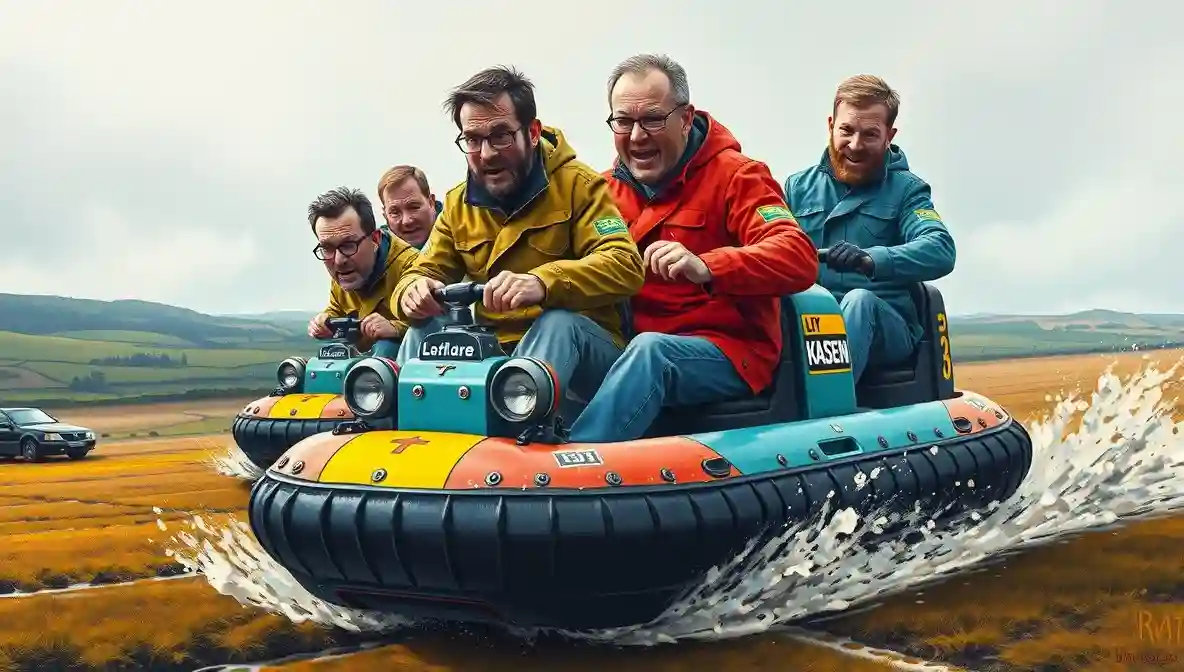
Local Men Discover Hovercrafting Is Just Lawn Mowing With More Panic
Craigluscar Activities is the place to go for a range of fun and exciting outdoor experiences.
Craigluscar Activities is a family-run outdoor adventure centre set on the scenic Craigluscar Hill near Dunfermline in Fife, Scotland, offering a range of hands-on experiences for individuals, families, groups and corporate outings — from hovercraft piloting and clay pigeon shooting to rifle shooting, archery and team-based mini Highland games like caber tossing, haggis throwing and tug o’ war — all with safety equipment and expert tuition provided. — [email protected]
Thrills, Spills, and Mild Injuries
The men arrived confident. They always do.

They arrived in branded fleeces, novelty sunglasses, and that peculiar posture men adopt when they believe today might involve heroism but secretly hope it won’t involve paperwork. Somewhere between the car park and the safety briefing, each man privately decided that hovercrafting would be “easy enough” and that the instructor was “probably over-explaining it.”
This was their first mistake.
Hovercrafting, the men soon learned, is not so much driving as it is negotiating terms with physics. The craft does not obey steering in the way cars do, or boats do, or even shopping trolleys do. It slides. It floats. It drifts with the unpredictable confidence of a drunk uncle at a wedding who has just discovered line dancing.
Within seconds, one man achieved full speed and immediately forgot how to stop. Another learned that turning left while thinking about turning right causes the hovercraft to continue forward out of spite. A third shouted, “THIS IS FINE,” moments before discovering a fence that had previously seemed theoretical.
Experts later described the experience as “lawn mowing, but the lawn fights back.”
“Mini Highland Games Cancelled After Majority Vote to Just Eat Haggis Instead”

The Mini Highland Games began, as all cultural events do, with optimism and laminated signs.
There were stations. There were scorecards. There were carefully laid cabers that no one fully understood how to lift without herniating something critical to sitting down later. For a brief moment, the group stood united in purpose: to honour Scottish tradition, vaguely, while remaining mostly upright.
Then someone opened the haggis.
Within minutes, the democratic process took over. A show of hands revealed a clear majority in favour of abandoning physical exertion entirely in exchange for standing near a table and discussing how “surprisingly good” haggis can be when you stop thinking about it too hard.
The tug-o’-war rope lay untouched. The caber leaned awkwardly, like a disappointed parent. The games were officially postponed, then quietly forgotten, then blamed on “logistics.”
Historians will later argue this was not a failure of sport, but a triumph of pragmatism.
Thrills, Spills, and Mild Injuries
“Family Enjoys Clay Pigeon Shooting — Pigeons Threatened to Sue After Event”
The family outing was meant to be wholesome.

There was a mum who brought snacks, a dad who said “I used to do this all the time” despite no evidence, and two teenagers who immediately asked if there was Wi-Fi. Together, they approached the clay pigeon range with the cautious enthusiasm of people who had watched exactly one YouTube video and decided that was sufficient training.
The pigeons, it should be noted, were clay. This did not stop several family members from expressing concern about the “emotional impact” of missing them repeatedly.
Shots rang out. Clays shattered. Somewhere, a pigeon-shaped object survived four direct attempts and earned a round of applause. One teenager announced they were “basically a sniper now” after hitting exactly one target out of twelve.
Legal experts later confirmed that no pigeons were harmed, but several egos were lightly bruised.
“Rifle Shooting Participants Shocked to Find Target Was ‘Just a Suggestion’”
Rifle shooting introduces men to a humbling truth: the target does not care about confidence.
Participants arrived with strong opinions about accuracy, stance, and “how hard could it be?” They left with newfound respect for inanimate circles and the quiet judgement they project.
One man blamed the wind. Another blamed the rifle. A third blamed “the vibes.” None blamed themselves, which experts agree is consistent with long-standing tradition.
Instructors gently explained that missing by several feet was “technically a miss,” while nodding in a way that suggested they had seen this exact performance many times before and would see it many times again.
Corporate Team Building Goes Rogue
“Office Workers Forced Into Tug-O’-War; Now Unionising Against HR”

The team-building day was mandatory, which immediately set the tone.
Office workers, stripped of ergonomic chairs and passive-aggressive email chains, were handed a rope and told this would “build trust.” It did not. It built resentment, followed by a WhatsApp group titled HR Has Gone Too Far.
Departments that previously communicated only through Outlook calendar invites were now screaming at one another over a muddy field. Marketing accused Finance of “not pulling their weight.” Finance responded by citing contractual obligations.
By the end, several employees had learned who they could trust, who would betray them for a free sandwich, and who should never, under any circumstances, be put in charge of morale.
“Team Building Day Ends in Betrayal During Haggis Throwing Showdown”
If the tug-o’-war revealed fractures, the haggis throwing exposed fault lines.
Rules were explained. They were ignored. Alliances formed quickly and dissolved even faster. One employee, previously known only for colour-coded spreadsheets, emerged as a ruthless competitor willing to sacrifice friendship for distance.
HR attempted to intervene but was drowned out by cheers, accusations of cheating, and someone yelling, “THAT WAS A PRACTICE THROW.”
Trust was not rebuilt. It was redistributed.
Hovercraft Hijinks
“Craigluscar’s Hovercraft Fleet: More ‘Float Like a Buffalo’ Than ‘Fly Like a Falcon’”
The hovercrafts sat quietly, waiting. They knew what was coming.
Described in brochures as “nimble” and “responsive,” the crafts demonstrated a personality closer to “stubborn” and “easily offended.” Steering inputs were treated as polite suggestions rather than commands.
Observers noted that every participant went through the same emotional stages:
-
Confidence
-
Confusion
-
Acceptance
One man attempted to reverse and instead achieved a slow, graceful spin that experts later described as “interpretive.”
“First Person to Master Hovercraft Navigation Offered Free Tea for Life”
It happened eventually.
One participant—quiet, unassuming, wearing gloves for no clear reason—figured it out. He leaned correctly. He anticipated drift. He stopped without panic.
Witnesses described the moment as “unnerving” and “possibly witchcraft.” The instructor nodded solemnly. A mug of tea was quietly promised, valid indefinitely.
The man refused interviews and disappeared into legend.
Archery Oddities
“Expert Instructor Advises ‘Aim At Target,’ Some Still Aim at Colleague”
Archery, it turns out, is harder when you are being watched.
Despite clear instructions, brightly coloured targets, and repeated demonstrations, arrows continued to travel in directions best described as “creative.” One participant asked if “close enough” counted. Another tried to blame the bow for “pulling left emotionally.”
The instructor remained calm, repeating the phrase “aim at the target” with increasing philosophical depth, as if speaking not just about archery, but about life.
“Local Dad Boasts He Can ‘Totally Hit That Bullseye’ (He Didn’t)”
Every group has this dad.
He announces his confidence early. He references a vague childhood memory involving summer camps or scouts. He misses immediately and then insists the bow is “set up wrong.”
His children document the entire process.
When he finally hits the target—somewhere near the edge—he celebrates like an Olympic champion and declares he was “just warming up.”
Deep Cultural Reporting
“Anthropologists Report New Highland Game Ritual Where Everyone Just Complains About the Weather”

Researchers observing the event noted a recurring behaviour: complaining.
Too cold. Too windy. Suddenly sunny, which is worse somehow. Participants bonded deeply over mutual dissatisfaction, suggesting this may be the most authentic Scottish tradition of all.
The complaints were not meant to solve anything. They existed purely to be shared, nodded at, and repeated with slight variations.
Experts agree this ritual strengthens social cohesion.
“Experts Say Dressing Warmly At Craigluscar Now Considered New Formal Scottish Attire”
Gone are the days of ceremonial dress.
The new formalwear consists of waterproof jackets, sensible boots, and layers added and removed hourly. Scarves appear without warning. Hats vanish mysteriously.
One visitor attempted denim. He was not seen again.
Fashion analysts predict this look will spread.
Tourism Takes a Turn
“Visitors At Craigluscar Shocked That ‘Outdoor Experience’ Requires Leaving Sofa”
Some visitors arrived unprepared.
They assumed “outdoor” was metaphorical. They asked about indoor options while standing outdoors. They expressed surprise at mud, wind, and the concept of walking.
Within minutes, they adapted, discovering muscles previously unknown and a renewed appreciation for sofas everywhere.
“Guide Teaches Life Lesson Through Archery: ‘Just Cause It’s Pointy Doesn’t Mean You Should Touch It’”
The final lesson came quietly.
After the activities, after the adrenaline, after the tea, the guide summed it up. Safety, focus, respect—for equipment, for people, for reality.
The group nodded. Someone dropped an arrow. No one touched it.
And in that moment, learning occurred.
Conclusion: A Nation Reflected in Mud and Mild Chaos
Craigluscar does not offer perfection. It offers something better: controlled disorder.
It reveals who panics, who adapts, who complains constructively, and who should never be trusted with a hovercraft. It strips away titles, job roles, and bravado, leaving only people trying their best not to fall over.
And that, experts agree, is where the real culture lives.

Megan Amram is a standup comedian based in Portland, OR. She is a native of North London.



Every institution eventually produces the story that defines it. This appears to be that moment and the Prat has arrived at exactly the right time.
What I appreciate most is the refusal to explain the joke. The piece trusts the reader and the reader is right to feel trusted.
Satire requires a shared understanding of what normal looks like. The Prat has correctly identified that normal has moved and adjusted its aim accordingly.
Earned detail. Observation.