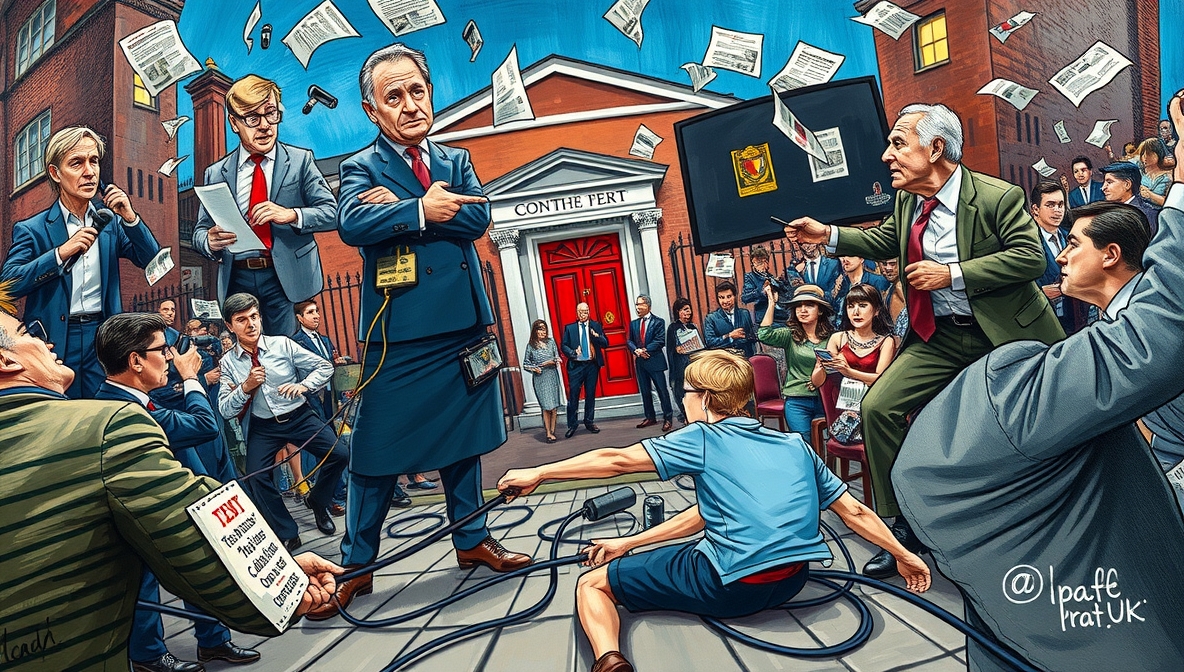
The holding area for government pledges operates smoothly whilst delivery remains pending
Deep inside Number 10 Downing Street, beyond the press briefing room and past the offices where optimism is routinely applied with a trowel, lies a quieter space known internally as the Holding Area. This is where promises are placed once they have been announced, applauded, and carefully separated from any expectation of delivery.
Officials insist the system is not a graveyard but a waiting room. “They’re not broken,” one aide explained. “They’re just pending.”
The Promise Management System
The room itself is said to be surprisingly comfortable. Promises are stacked neatly on shelves, labelled with phrases like “after consultation,” “subject to review,” and the ever-popular “in due course.” Some are wrapped in manifesto paper, others in coalition language. A few older ones have developed a thin layer of dust and self-awareness.
One long-serving civil servant admitted some promises have been waiting so long they’ve stopped asking questions. “They understand how this works,” the official said. “They’re very mature about it.”
Among the longest residents are pledges on housing, social care reform, and simplifying the tax system. These are occasionally taken down, shown briefly to the public, then returned to the shelf with a reassuring pat.
Responsible Governance Through Supervision
Downing Street insists this is responsible governance. “You can’t just release promises into the wild,” a spokesperson said. “They need supervision.”
When asked how long promises typically remain in the holding area, officials declined to give a timeframe, noting that time inside No. 10 behaves differently. “A year outside is about six weeks in here,” one aide said. “Or six parliaments.”
Each promise undergoes regular review to ensure it still sounds appropriate when mentioned in passing. Those that no longer fit current priorities are gently reclassified as “ambitions” or “aspirations,” allowing them to remain technically alive while functionally inert.
Accountability Through Rotation
Critics argue the system allows the government to accumulate pledges without consequence. Downing Street rejects this, pointing out that promises are carefully rotated to give the impression of movement.
“We bring them out, talk about them, then put them back,” said a senior adviser. “That’s accountability.”
Occasionally, a promise escapes. These incidents are rare and treated seriously. Last year, an unexpected delivery reportedly caused confusion across multiple departments, prompting an internal inquiry and a renewed commitment to containment.
Public Awareness Growing
Public reaction to the existence of the holding area has been muted, largely because many suspected it already existed. “I always assumed promises went somewhere,” said one voter. “Nice to know they’re warm.”
Downing Street maintains the system is essential to maintaining stability. “Imagine if we tried to deliver everything we said,” an aide mused. “The disruption would be enormous.”
As the briefing ended, the spokesperson reassured journalists that promises are safe, monitored, and very much part of the process.
“They’re not forgotten,” they said. “They’re just waiting for the right moment.”
That moment, officials confirmed, remains under review by Westminster authorities and political observers.

Alan Nafzger was born in Lubbock, Texas, the son Swiss immigrants. He grew up on a dairy in Windthorst, north central Texas. He earned degrees from Midwestern State University (B.A. 1985) and Texas State University (M.A. 1987). University College Dublin (Ph.D. 1991). Dr. Nafzger has entertained and educated young people in Texas colleges for 37 years. Nafzger is best known for his dark novels and experimental screenwriting. His best know scripts to date are Lenin’s Body, produced in Russia by A-Media and Sea and Sky produced in The Philippines in the Tagalog language. In 1986, Nafzger wrote the iconic feminist western novel, Gina of Quitaque. Contact: editor@prat.uk